The Art of Sound: Oswalds Mill Audio and the Cinema Heritage of High-End Audio
When most people think about high-end audio, they imagine sleek modern electronics and carefully engineered digital components. But the roots of truly exceptional sound stretch back nearly a century, to the golden age of cinema - to the vast theatres of the 1930s where Western Electric and RCA engineered speaker systems so remarkably capable that, decades later, the world's most discerning audiophiles are still chasing their standard. At Stereo Types, we believe that understanding where great sound came from is the key to understanding why certain systems sound so extraordinary today. That philosophy is precisely what drives Oswalds Mill Audio (OMA) - one of the most singular audio companies in the world and a brand that represents everything we stand for in high-end system design.
The Forgotten Science of Cinema Sound
Before digital audio, before solid-state amplifiers, before the miniaturisation of everything, there was the cinema. In the 1930s, companies like Western Electric and RCA developed horn-loaded speaker systems driven by triode vacuum tube amplifiers to fill enormous movie palaces with clear, powerful, natural sound. These systems were engineered to reproduce the full scope of an orchestra or the resonance of a human voice - without distortion, without compression, without compromise.
Then, as the audio industry shifted focus toward convenience, portability, and cost reduction, that technology was largely abandoned. Smaller speakers, solid-state amplifiers, and digitally compressed audio became the norm. The world forgot how good sound could actually be.
OMA founder Jonathan Weiss did not forget.
Who Is Jonathan Weiss, and What Is OMA?
Jonathan Weiss graduated from Princeton and the London School of Economics, where he studied International Relations and Public International Law. He then became a self-taught filmmaker, creating the critically noted non-narrative feature adaptation of J.G. Ballard's novel The Atrocity Exhibition - a film Ballard himself described as a poetic masterpiece. Weiss also created The Global Kitchen in the early 1990s, one of the first global food travel shows on television, years before the format became a television staple.
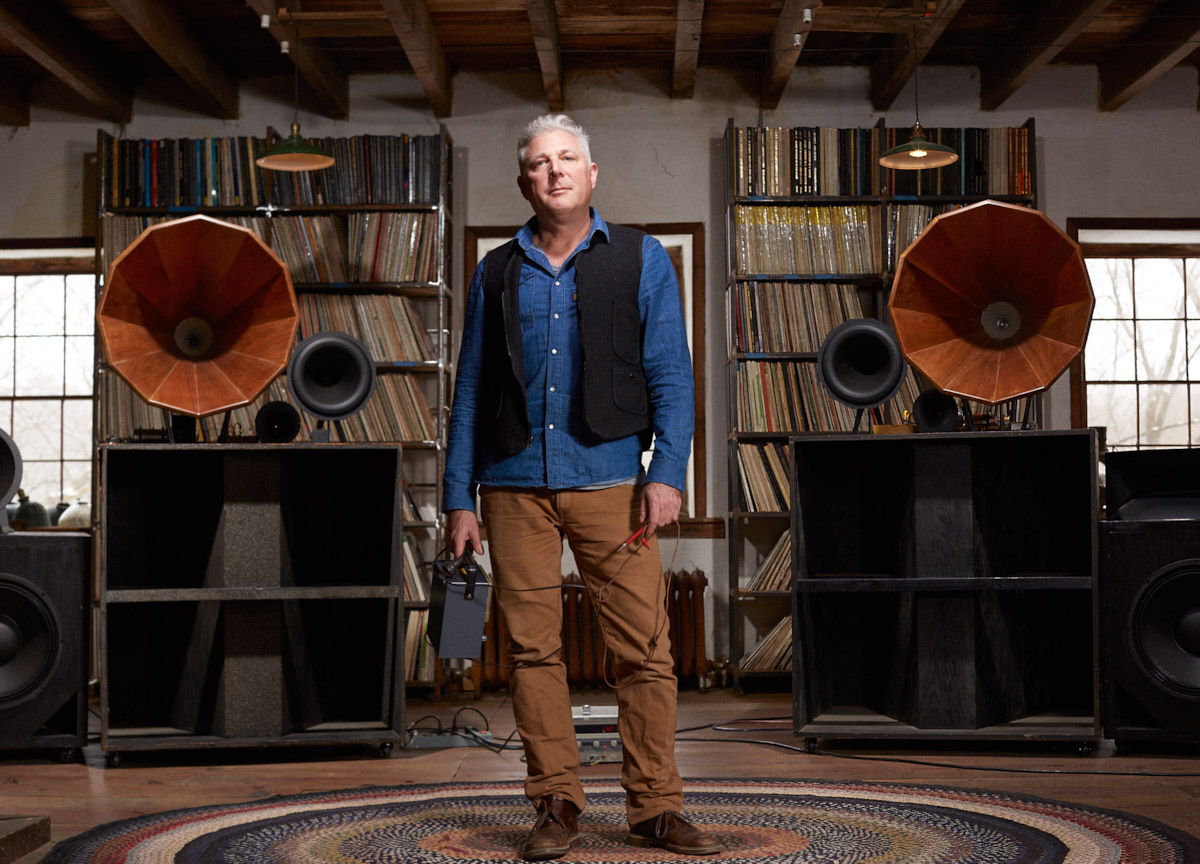
It was through his life as a filmmaker and cultural explorer that Weiss encountered a truth about sound that most of the audio industry had quietly buried: the finest sound quality ever produced by human engineering originated not in the modern audiophile market, but in the cinema speaker systems of the 1930s - horn speakers paired with triode vacuum tube amplifiers, built by Western Electric and RCA.
OMA was Weiss's response. Founded at his studio and showroom in the DUMBO neighbourhood of Brooklyn, New York — a loft he renovated before the neighbourhood became a cultural landmark - OMA assembled some of the world's finest horn speaker designers, tube amplifier engineers, turntable craftsmen, and industrial designers under one roof. The result is a line of audio equipment without a peer in the modern high-end market.
The OMA Philosophy - Horn Speakers and Why They Matter
The heart of OMA's technical approach is the horn loudspeaker, a design rooted in the cinema engineering of the 1930s that most contemporary audio companies have abandoned in favour of smaller, cheaper alternatives.
Here is why horn speakers are fundamentally different - and superior — to conventional designs:
- Conventional loudspeakers radiate sound in every direction, creating unwanted reflections off walls, ceilings, and floors that muddy the listening experience and require significant acoustic treatment to manage.
- Horn speakers are directional. Sound is aimed precisely where the listener sits, dramatically reducing room interactions and delivering a more natural, lifelike presentation.
- Horn speakers are far more efficient. Nearly all OMA loudspeakers achieve sensitivity ratings above 100dB at 1 watt at 1 meter. A conventional high-end speaker typically measures 83–85dB - a figure that sounds close, but given the logarithmic nature of the decibel scale, requires approximately 100 times more amplifier power to produce the same volume.
That efficiency has a profound consequence: OMA speakers can be driven by low-power triode tube amplifiers, which OMA argues — and a century of evidence supports - produce the most musically accurate sound available. Low-power triode amplifiers were the standard in cinema speaker systems of the 1930s. OMA has brought that combination forward into the 21st century.
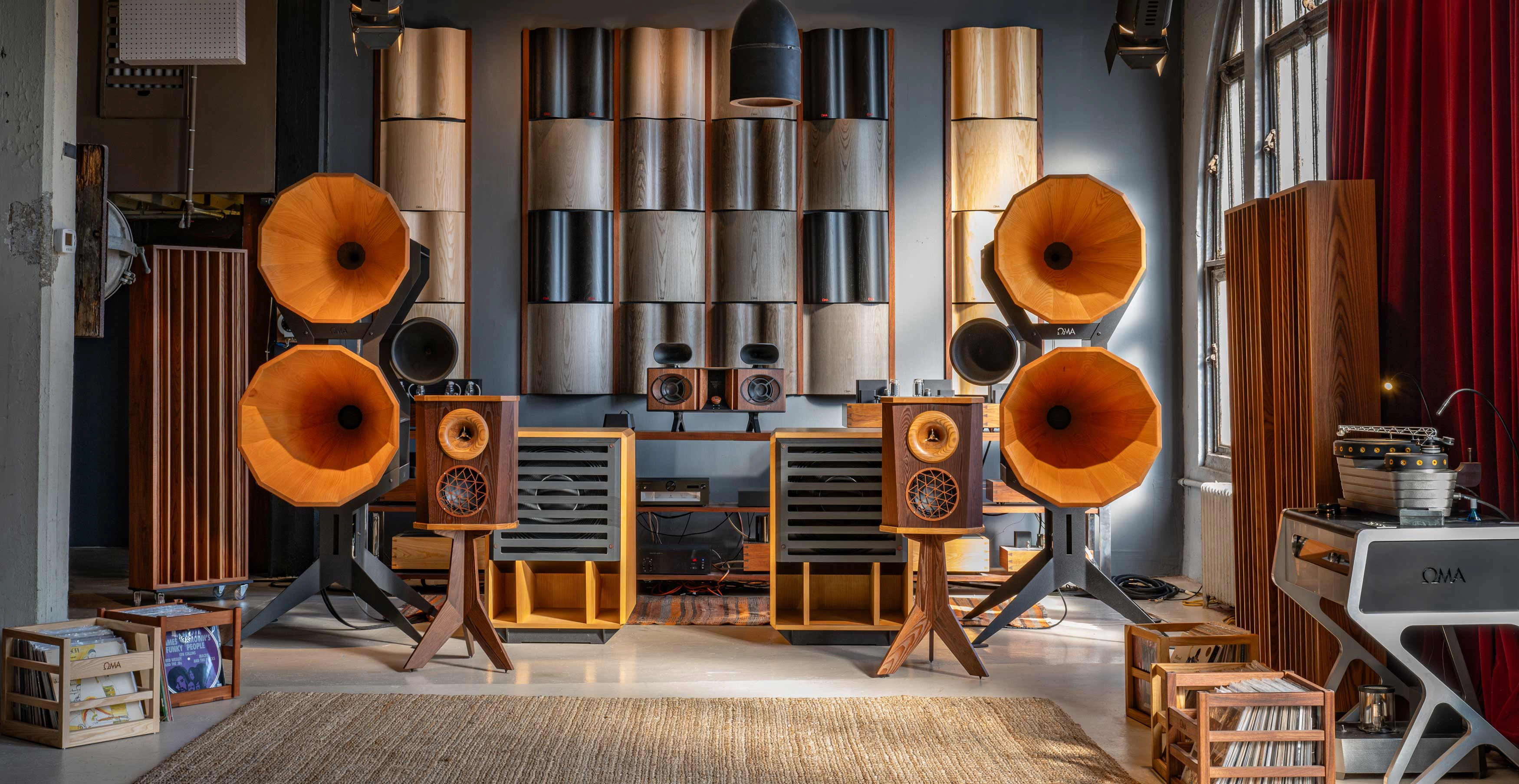
OMA is also notably the only high-fidelity company in the world that relies exclusively on the conical horn profile in its speaker designs. The conical profile - meaning the horn walls are straight rather than curved - does not deform the spherical sound wave produced by the horn. Every other manufacturer uses curved-wall horn designs, which are physically smaller but introduce measurable distortion to the wave. OMA's speakers are larger as a result, but the acoustic integrity is uncompromised.
Handcrafted in Eastern Pennsylvania
Every OMA product is manufactured within a small area of eastern Pennsylvania - the same region that gave birth to America's industrial revolution and continues to support skilled small-scale manufacturing. OMA's horns are cast at a local foundry. Their slate components come from the last active slate quarry in Pennsylvania. Wood is sourced from surrounding forests. Many products are built entirely by hand by skilled artisans, though OMA also employs advanced technologies such as five-axis water jet machining where precision demands it.
The acoustic design work is led by Bill Woods, who has spent more than 35 years designing horn loudspeakers professionally and is considered one of the world's foremost experts on horn acoustics. Industrial design is handled by David D'Imperio, who gives each OMA speaker a visually distinct identity rooted in its acoustic function. The result is a product line that is simultaneously a functional instrument and a work of sculptural art.
OMA's loudspeaker lineup includes models such as the Imperia, the AC1, the Ironic, the Mini, the Monarch, the Monitor, and the Museum Speaker — the latter created specifically for the Guggenheim Museum, where it appeared in a major exhibition. The amplifier lineup includes the Special K triode tube amplifier, the Black Knight BK807, the Parallax PL519, the Hollander, the PD2, the Metamorphosis, and the TS-1, among others. OMA also manufactures turntables, tonearms, audio furniture, acoustic treatment panels, and cables — making it possible to build a complete OMA system from signal source to speaker without introducing components from other manufacturers.
Why Stereo Types Represent This Tier of Audio
At Stereo Types, our mission has always been to bring the world's finest audio and visual technology into exceptional spaces. We design and install bespoke systems for luxury residences, mega yachts, executive offices, hospitality environments, and elite living spaces across New York, the Northeast, Virginia and the Mid-Atlantic, Florida and the Southeast, and beyond.
The brands we work with - including Control4, Crestron, Savant, Lutron, McIntosh, Bowers & Wilkins, Storm Audio, Meridian, Sony, and Digital Projection - represent the pinnacle of their respective categories. OMA occupies a unique position within this ecosystem. It is not simply a loudspeaker manufacturer. It is the closest thing the modern audio world has to a complete revival of the cinema engineering tradition - an approach that treats music reproduction not as a background feature but as the main event.
When we integrate OMA systems into a listening room or home theatre environment, we are not simply placing speakers and connecting cables. We are designing an acoustic experience rooted in nearly a century of engineering knowledge, handcrafted in Pennsylvania, and delivered with the precision integration and ongoing support that Stereo Types clients expect.
A Conversation Worth Having
If you have ever sat in a room with an OMA system playing and felt something you could not quite explain - a sense that the music was happening in front of you rather than being reproduced through a box - you already understand what this technology does. If you have not yet had that experience, we believe it is one worth seeking out.
Stereo Types works with clients throughout the Mid-Atlantic, New York, the Southeast, and beyond who are ready to approach their audio environments with the same seriousness they apply to the design and craftsmanship of every other aspect of their lives. If that describes you, we welcome the conversation.