Why Do Yacht AV Systems Demand a Different Approach?
A yacht is not a house that floats. It moves, it flexes, it runs on its own power, and it sits in salt air every day of its life. Audio, video, lighting, and control systems built for a home will not survive that environment for long — and if they do survive, they rarely perform the way the owner expected.
At Stereo Types, we have designed integrated systems since 1976 across the Mid-Atlantic and the Northeast. The engineering discipline behind a marine system is different from a residential one, and it is worth explaining where those differences actually come from.
The Salt Air Problem Never Stops
Corrosion is the first and most constant threat. Salt-laden air reaches speaker grilles, connector pins, rack terminals, and outdoor display housings even when a vessel is docked. Standard residential hardware uses materials that were never tested for this exposure.
Marine-rated equipment answers the problem with different material choices:
Marine-grade stainless steel or powder-coated aluminium instead of untreated steel
Sealed enclosures with gaskets rated for water and dust ingress
UV-stable polymers for grilles and baffles that face open sky
Conformal coatings on circuit boards in exposed locations
Tinned copper cable, which resists corrosion far better than bare copper
Skipping any of these saves money once and costs money repeatedly.
Everything on Board Is Moving
A building is static. A yacht pitches, rolls, and vibrates from engines and generators, and the hull itself flexes under load. That constant motion works against ordinary mounting hardware.
This changes how we specify and secure equipment. Racks need vibration isolation and positive mechanical fixing, not friction fits. Displays require mounts designed for dynamic loads rather than a fixed wall bracket. Cable runs need proper strain relief and regular anchoring so connectors are never carrying weight. Loose terminations that would last decades in a house can work themselves free at sea in a single season.
Power Behaves Differently at Sea
Onboard electrical supply is more complicated than a wall outlet. A vessel may run on shore power in one port, generator power at anchor, and inverter power overnight. Voltage and frequency can change between regions — 120V at 60Hz in the United States, 230V at 50Hz across much of Europe.
Sensitive amplifiers, processors, and displays do not tolerate that variation well. Systems need clean, conditioned, correctly grounded power, and equipment selected to handle switching between sources without interruption. Power draw also matters more than it does ashore, because every watt competes with navigation, climate, and galley systems for a finite supply.
Space and Weight Are Fixed Budgets
Interior volume on a yacht is the most expensive commodity aboard. There is no spare closet to convert into an equipment room, and adding weight high in the vessel affects stability.
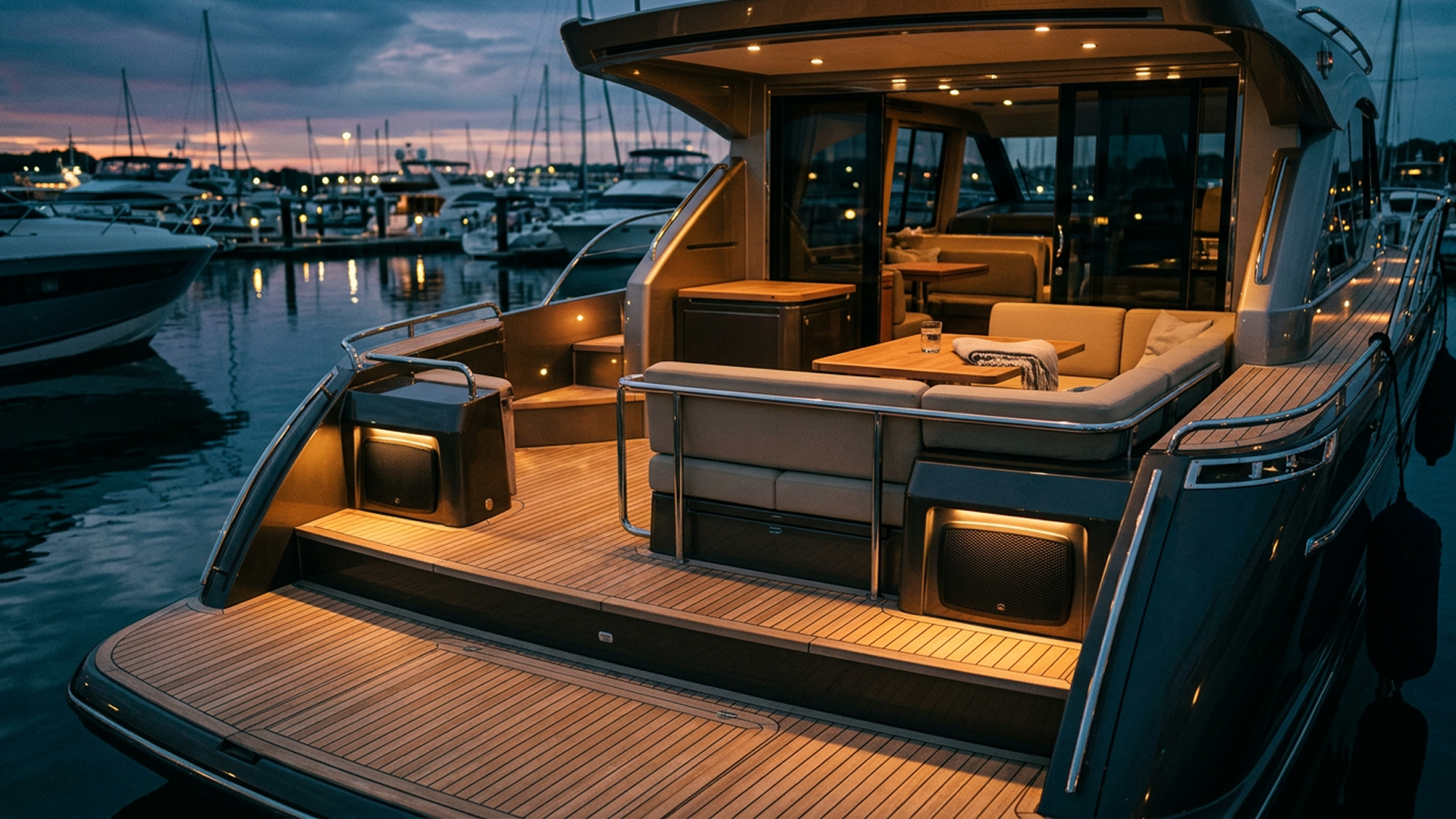
This is why marine AV design starts with the naval architect's drawings rather than a product list. Equipment racks are often custom-fabricated to fit an odd void. Speakers are frequently flush-mounted into joinery that has been shaped for them. Cable pathways must be agreed before panels close, because opening finished bulkheads later is expensive and sometimes impossible. Decisions that are reversible in a house are permanent on a boat.
Connectivity Cannot Be Assumed
Ashore, streaming is a solved problem. Offshore, it is not. Satellite links and maritime cellular service vary by position, weather, and distance from coast, and bandwidth is often shared with navigation and communication traffic.
A well-designed onboard system therefore keeps content local. Stored media servers hold films and music aboard so entertainment does not depend on a live connection. The network is built to prioritise critical traffic and to fail gracefully when the link drops, rather than leaving guests with a blank screen in the middle of a passage.
The Network Is the Real Foundation
Modern integrated systems — video distribution, audio zones, lighting, shades, climate, and control interfaces — all run over the same network. On a yacht, that network has to work across decks, through metal structures, and around equipment that generates significant electrical noise.
We treat the network as infrastructure, not as an accessory. That means structured cabling, managed switches, carefully planned wireless access point placement, and separation between guest traffic and system traffic. A system that is elegant on paper will still frustrate an owner if the network underneath it was an afterthought.
Acoustics on Board Are Genuinely Difficult
Yacht interiors are acoustically hostile. Surfaces are hard and reflective — glass, lacquered wood, stone, and metal. Rooms are small and often irregular in shape. There is a constant background of engine, generator, and sea noise. Exterior spaces on the flybridge or aft deck have no boundaries at all, plus wind.
Good results come from careful driver selection, correct speaker placement, and digital signal processing tuned to each zone individually. A saloon, a master cabin, and an open sun deck need three different solutions. Brands we work with, including Bowers & Wilkins, McIntosh, Sonance, and Storm Audio, offer the performance and processing needed to make that tuning possible.
Service Access Is Limited by Nature
If a home system develops a fault, a technician visits the following week. If a yacht system fails, the vessel may be in another country. This reality shapes design decisions from the beginning.
Practical measures include remote monitoring and diagnostics, control platforms such as Crestron, Control4, and Savant that support secure remote access, clear labelling and documentation of every run, accessible rack layouts for onboard crew, and sensible spares held aboard. The aim is that most issues are resolved without a physical visit.
H2: Talk to Us Before the Refit Starts
The single best decision an owner can make is to involve the integration team early — during design or refit planning, not after the joinery is finished. Early involvement protects cable routes, equipment spaces, power allocation, and mounting points while changes are still inexpensive.